Local Plan 2045 Scoping Consultation
Other elements in this consultation
1. Introduction
What we’re doing and why
1.1The council is getting ready to start preparing a new Chichester Local Plan to replace the Chichester Local Plan 2021 – 2039 and the Site Allocation Development Plan Document 2014 – 2029. A new local plan is needed to respond to changes in national policy and to ensure that future development is properly planned and supported by infrastructure.
1.2As we plan to 2045, we face a range of challenges including meeting significantly increased housing needs, supporting the local economy, responding to climate change and addressing locally specific issues.
1.3The new Chichester Local Plan 2045 will establish the vision, measurable outcomes and a spatial strategy for the sustainable development of the Chichester plan area over the period to 2045.
1.4It will be informed by assessments of need for housing (including affordable housing and specialist accommodation), employment and other appropriate land-uses. To meet identified needs, the new Chichester Local Plan will allocate land and provide locally specific policies to manage development.
What is this consultation about?
1.5This document is the first stage in getting ready to prepare our new local plan. We want to hear your views on what the plan should contain and what matters most to you, as well as feedback on how you want us to engage with you throughout the plan-making process.
1.6This consultation seeks your views on the scope of the new local plan—in other words the topics, issues and priorities it should address.
1.7At this stage:
- we are not proposing specific sites or detailed policies
- we are asking for your views on what the plan should cover
- your responses will help shape the next stage where we will start plan preparation
Why do we need to update the local plan?
1.8It is a statutory requirement that local authorities produce a local plan for their area and keep it up to date. While the council has a recently adopted local plan covering the plan area, planning reforms and new local plan regulations mean that the council is required to undertake an immediate review of its local plan and formally commence work in June 2026. This is because the adopted local plan housing requirement is less than 80 per cent of the latest government assessment of housing need for the Chichester plan area. The new Chichester Local Plan will provide strategic and local policies that will help and guide the delivery of sustainable development to 2045.
1.9The council needs to plan to meet the latest assessment of local housing need and employment. It will also be important to continue to have an up-to-date local plan in place so we maintain a plan-led approach for sustainable development in the plan area. In the absence of a local plan that identifies and allocates land for housing, unplanned sites are more likely to come forward through speculative planning applications. Without a supply of land identified in a local plan, it would be difficult to refuse applications, even if people may think they are on inappropriate sites. This increases the risk of unplanned, speculative development.
What’s the process for updating our local plan?
1.10The Chichester Local Plan 2045 will be prepared through a series of clearly defined stages over approximately 30 months. It’s important to note that the 30-month timescale that our timetable is based on is the government’s aspiration for how quickly plan-making should progress under the new plan-making system. The reality is that plan-making is a complex process that requires issues to be resolved and resolving issues can lead to delays, particularly where they are unforeseen. Even under this quicker system, preparing a local plan will still take time and may end up taking closer to 3 or possibly even 4 years. This is because there is a lot of work to do. We need strong evidence to support the plan. We must follow the law. We must work closely with stakeholders and local communities as this enables them to give their views as the plan develops.
Early preparation (‘Get ready’ stage)
1.11At this stage in the plan-making process we are ‘getting ready’ to start plan-making. This stage is before formal plan-making begins.
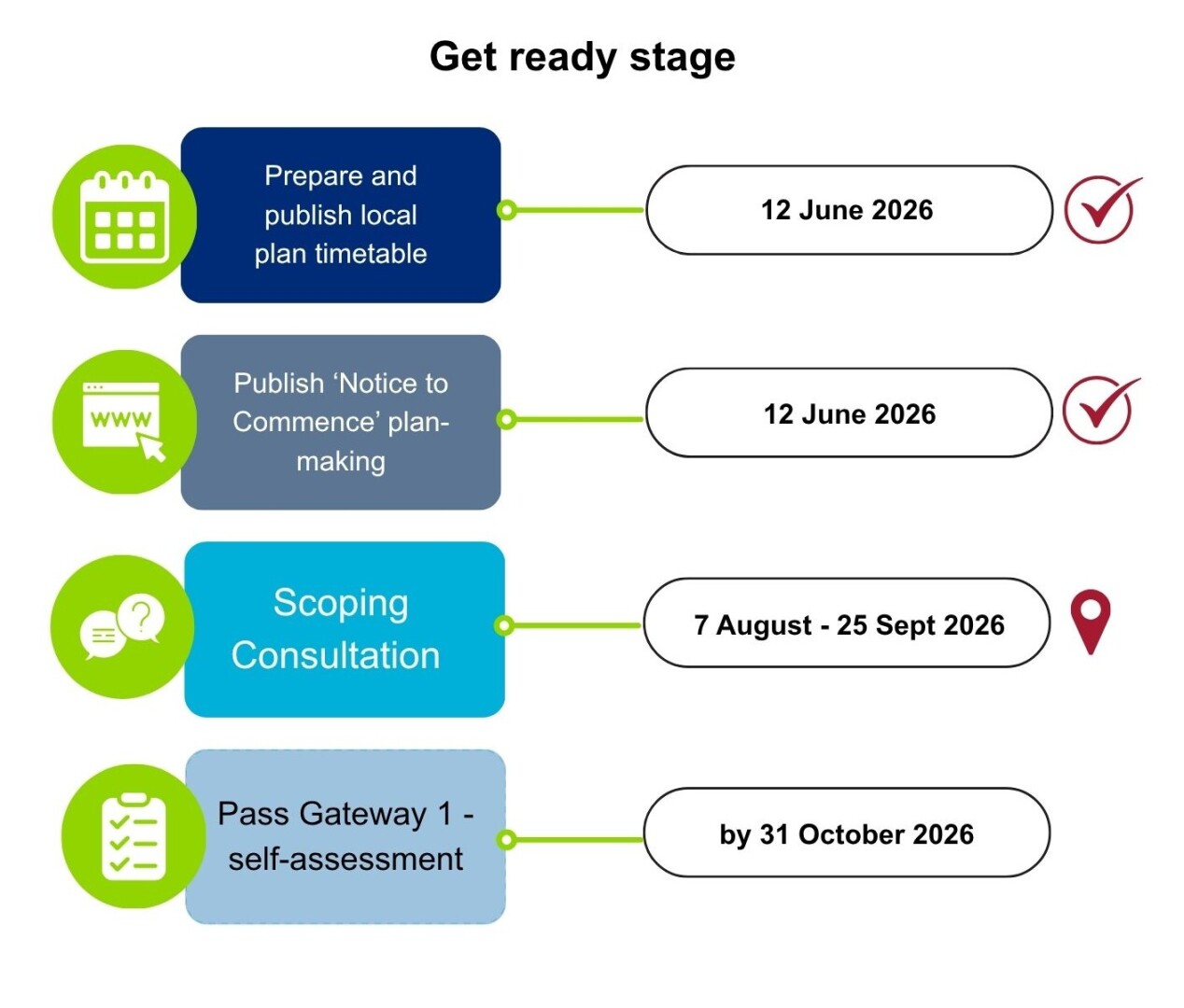
1.12We published a formal ‘notice to commence plan-making’ on 12 June 2026, alongside an up-to-date timetable setting out key milestones.
1.13We are carrying out early work including gathering baseline information, starting to think about an initial vision, understanding land availability, and starting to collect evidence. A ‘call for sites’ has already taken place, and initial site assessments are underway. This work, together with the feedback we gather during the scoping consultation will be used to help us complete the initial ‘Gateway 1’ self-assessment. This first public consultation seeks early views on what the plan should contain and how we should engage. Following this, we will complete a Gateway 1 self‑assessment to confirm we are ready to proceed. Successful completion of Gateway 1 will mark the start of the 30‑month plan preparation period.
1.14The ‘get ready’ stage involves the following steps:
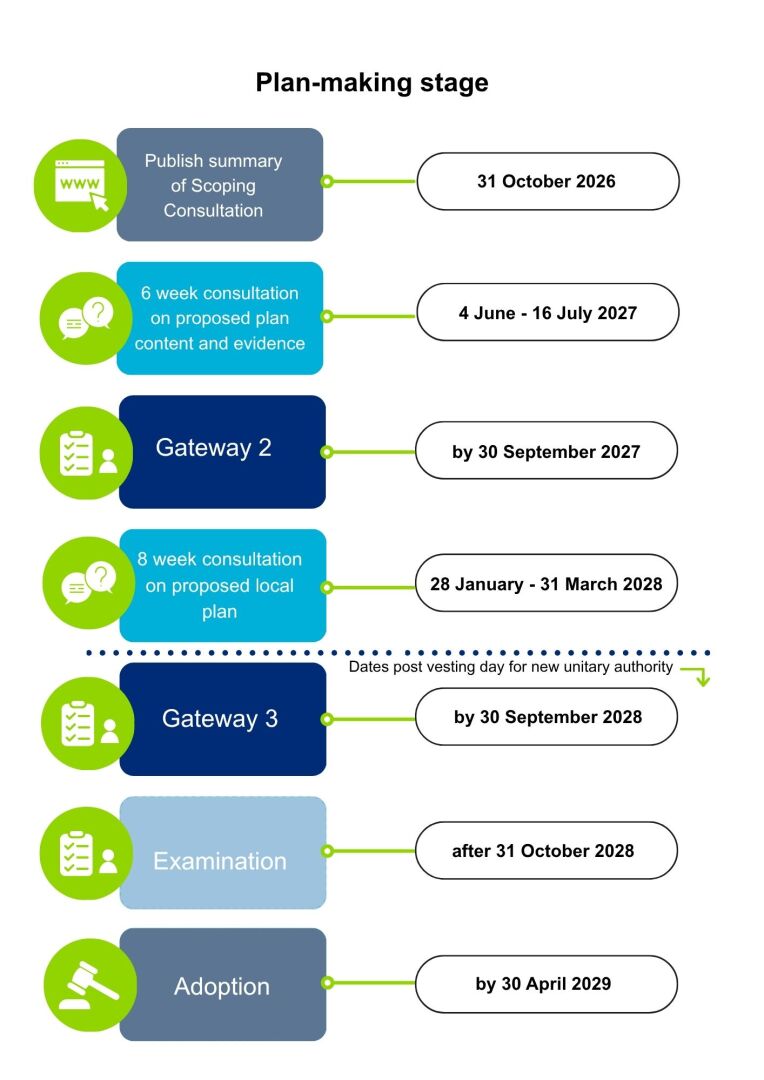
Preparing the plan (Months 1–23)
1.15We will:
- develop a draft vision, objectives and spatial strategy options;
- continue site assessments and evidence gathering;
- undertake a second public consultation on emerging content (including strategy options, policies and potential sites); and
- prepare a full draft local plan with supporting evidence and environmental (SEA) report
1.16A Gateway 2 check with the Planning Inspectorate will provide early advice to help ensure the plan is on track.
Proposed plan consultation
1.17A further consultation will invite comments on the full proposed local plan and supporting documents before finalising the submission version.
Gateway 3 and submission
1.18At Gateway 3, the Planning Inspectorate will review whether the plan is ready for examination. Once passed, the plan will be formally submitted.
Examination (Months 24–29)
1.19An independent Inspector will examine the plan to assess whether it is sound. This may include public hearings and potential modifications.
Adoption (Months 30–31)
1.20If found sound, the council will adopt the plan at a full Council meeting. A final policies map will then be published, showing all site allocations and designations.