Draft Engagement Strategy
Other elements in this consultation
1. Introduction
1.1This Engagement Strategy has been produced to underpin the preparation of the new Chichester Local Plan 2045 (CLP). This is being prepared under the new plan-making system. It relates to the Chichester plan area (the area of Chichester district outside the South Downs National Park) and will cover the period up to 2045.
1.2Planning impacts everyone - planning decisions determine the delivery of houses, employment, open spaces, the roads we travel on, and how climate change is managed. As such, the new CLP will affect everyone who lives and works within the Chichester plan area, meaning it is vital that local people, stakeholders, and relevant bodies are able to participate fully and effectively in the local plan-making process. It is especially important to involve communities and those affected by the Plan at an early stage in the process. We are committed to actively and meaningfully engaging residents, communities, partners and statutory bodies in the preparation of the Chichester Local Plan 2045. The involvement of local people is key to shaping a plan that enables sustainable growth, meets the needs of our communities, and protects and enhances our area. This Engagement Strategy sets out how the council will deliver early, inclusive and meaningful engagement throughout the plan-making process.
1.3This Engagement Strategy sets out how the council will involve people in the preparation of the new Chichester Local Plan 2045. It provides guidance to explain the various consultation stages in the plan-making process, how and when people can participate in the process, and what respondents can expect if they choose to get involved. The council has an existing Statement of Community Involvement (SCI)[1] which will remain in place because the Southbourne Allocation Development Plan Document is still being prepared and submitted under the legacy plan-making system. However, the SCI will only apply to plans made under the legacy planning system, and so the Engagement Strategy will replace the SCI for any future plans made under the new plan-making system.
2. Purpose, legal context and compliance
2.1The Engagement Strategy has been prepared in accordance with the Town and Country Planning (Local Planning) (England) Regulations 2026, which came into force on 25 March 2026. This introduces a simplified and faster plan-making process.
2.2The new plan-making process includes three consultations. Government guidance outlines how local planning authorities (LPAs) should only hold additional formal consultations where it is critical to delivering the plan.
2.3Part of the process under the new plan-making system requires a well-defined community engagement strategy. This strategy should set out the purpose, target audience and the objectives of the council’s formal strategy for engaging communities, stakeholders and statutory bodies in the preparation of the new CLP, and progress should be made in the approach to consulting and engaging on the plan before writing and publishing the Gateway 1 self-assessment summary.
3. Government Guidance
3.1This Engagement Strategy has been prepared with full regard to government guidance on plan-making and engagement. This includes:
- The National Planning Policy Framework (NPPF)
- The Government’s ‘Create or update a local plan using the new system’ guidance
- The Planning Advisory Service (PAS) ‘Local Plan Route Mapper and Toolkit 2025’
Draft National Planning Policy Framework (2025)
3.2The Ministry of Housing, Communities and Local Government published a revised NPPF in 2025 for consultation. Government guidance[2] states that if you are preparing a plan in the new system, you should have regard to the consultation draft of the NPPF (2025), to help inform the early stages of plan preparation. This Strategy pays consideration to the sections on plan-making, early community involvement, and strategic cooperation contained within the consultation draft of the draft NPPF (December 2025).
3.3A key consideration from the draft NPPF (December 2025) is PM6 which states that:
“All plan-makers should, in preparing plans engage positively with communities and other key stakeholders, at appropriate points during their preparation and using a range of methods, so that relevant issues are identified and addressed as early as possible during the plan-making process”
3.4Part of the revisions to the NPPF, and the new regulations, removed the statutory ‘duty to cooperate’, which placed a legal requirement for LPAs to work collaboratively with neighbouring authorities on strategic, cross-boundary planning matters. However, despite the statutory duty being removed, PM10 of the proposed NPPF (2025) sets out that LPAs should still maintain cooperation between plan-making authorities. Consequently, this remains an important part of the engagement process.
Create or update a local plan using the new system
3.5The plan-making guidance produced by the government at the time of writing this document is being reviewed. As such, it is subject to change. This document will be updated throughout the course of the plan-making process to ensure it remains consistent with the most up-to-date government guidance.
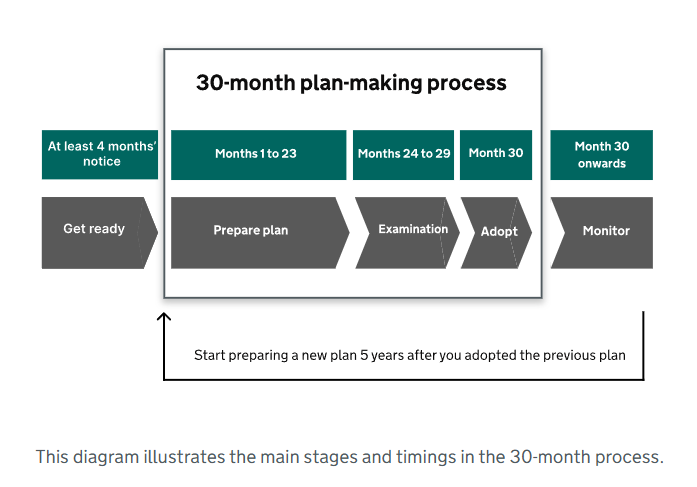
3.6This Strategy has been produced during the ‘getting ready’ stage of the plan-making process. Government guidance outlines how ‘getting ready’ forms an important part of the process, and should be done before the 30-month plan preparation process. The ‘getting ready’ stage means making progress in five areas, including the proposed approach to consulting and engaging on the plan. It emphasises the need for early engagement from stakeholders by running a scoping consultation.
3.7A scoping consultation must address matters including what the plan should contain, and how LPAs will engage with stakeholders going forward. Before Gateway 1 it is recommended that a strategy for engaging the community and other key stakeholders is prepared, in line with government guidance. Government guidance also recommends outlining a clear process to maximise responses from a diverse range of stakeholders (both digital-first and traditional methods) and to seek feedback from key decision makers when developing the strategy.
3.8The government has published new draft guidance on creating or updating a local plan using the new system[3]. This includes a section on engaging stakeholders and communities, providing guidance on how to carry out consultations, defining community engagement strategy, and making documents available for public inspection.
Engaging the public when preparing a local plan
3.9The government guidance provides advice on how LPAs must engage with certain consultation bodies and the local community on their local plan to garner a range of views on the area’s future.
3.10It states that when preparing a local plan, LPAs must carry out a:
- scoping consultation
- consultation on the proposed plan content and evidence
- consultation on the proposed local plan itself
3.11After each consultation, a summary setting out the feedback received and an explanation of how the LPA has considered the feedback must be published.
3.12The guidance states that an engagement strategy should:
- have regard to government guidance; and
- have clear processes in place to maximise responses from a diverse range of stakeholders, using both digital-first and traditional methods.
3.13In addition to the above, this Strategy sets out:
- how and when stakeholders will be engaged;
- how engagement activities will be inclusive, proportionate and purposeful;
- how the council will use a digital-first but accessible approach; and
- how feedback will shape the local plan at each stage.
Making your local plan documents publicly available
3.14Government guidance states that when preparing a local plan, LPAs are required to make certain documents available for public inspection. LPAs must:
- publish them on their website or, if preparing a joint local plan, certain documents can be published on a website for the joint plan; and
- have them available at the main office, and at such other places within the local plan area that the LPA considered appropriate, during normal office hours.
3.15When publishing information on the website, it should be machine readable, in a searchable format, and be easy to navigate and accessible to different users.
3.16Paper copies of documents must also be provided as soon as reasonably practicable after receiving a request. A reasonable charge to cover the cost of printing, posting and packaging for requests can be made.
Requirement to assist notice
3.17The government has issued draft guidance on how LPAs can get information needed from prescribed bodies to assist with local plan-making. This is a last resort option, but it enables LPAs to issue a requirement to assist notice to prescribed bodies for information that is needed and essential to plan-making.
Advice produced by the Planning Advisory Service (PAS) including the ‘Local Plan Route Mapper and Toolkit’
3.18The PAS ‘Local Plan Route Mapper and Toolkit’ is designed to help LPAs navigate the plan making process. It provides a framework to help generate creative responses to the procedural and technical requirements to enable efficient and effective plan making, as well as the delivery of positive ‘real world’ outcomes.
3.19PAS also provide a ‘Local Plan Project Initiation (PID) Document Template and Guidance’. It outlines the need for engagement approaches to consider:
- the main stakeholder groups and specify the key inputs needed from each – and at what plan stage we will be seeking this;
- what main stakeholder groups are necessary for joint working/cross-boundary working including specific engagement with neighbouring LPAs (including ward members);
- councillor engagement including a summary of its key elements of engagement points (for example workshops);
- appropriate engagement methods for each stage of the plan-making process, ensuring time is used effectively;
- underrepresented groups, and demographics;
- formal milestones in the plan making process relating to consultations; and
- foster strong relationships with stakeholders.
4. Local Plan Stages
4.1This section details the process of producing a local plan under the new plan-making system, and the opportunities available for engagement at each stage. The current published timetable for the Chichester Local Plan 2045 is set out below. This sets the key milestones for the end-to-end process for preparing the plan. The dates beyond 1 April 2028 will be subject to change as Chichester District Council will be incorporated into a new unitary authority after vesting day following local government reorganisation.
4.2Part two of the Planning and Compulsory Purchase Act 2004 as amended details the new sequence of the plan-making steps:
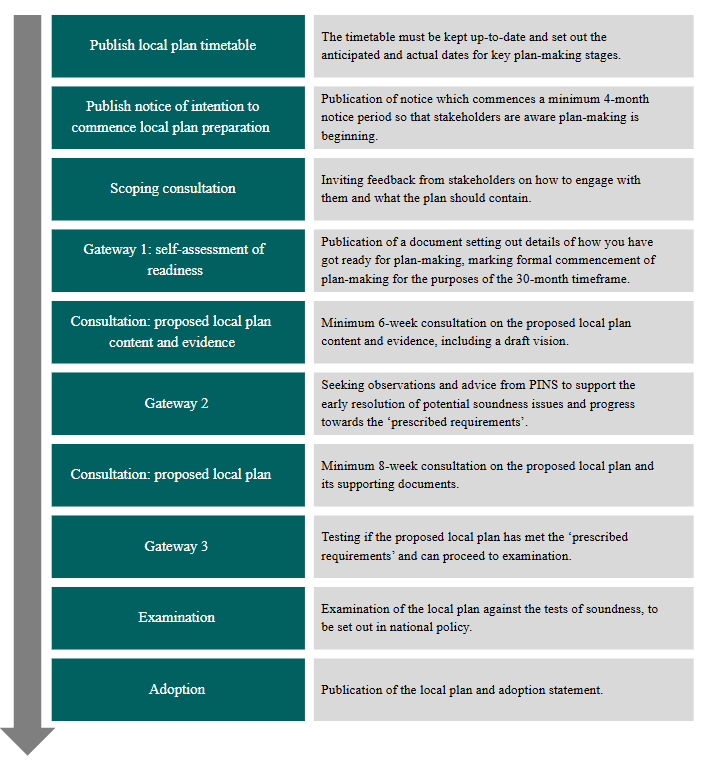
Table 1 below details the published timetable that Chichester District Council intends to follow, including the stages that representations can be made and who must be consulted.
|
Key Chichester Local Plan Milestones |
Opportunity for engagement? |
Who will be consulted? |
|---|---|---|
|
We will make our notice of intention to commence plan preparation available |
||
|
The scoping consultation will start and end |
Yes |
General consultation bodies and specific consultation bodies who may have an interest in the preparation of the local plan |
|
We will publish our Gateway 1 self-assessment summary |
||
|
The consultation on proposed plan content and evidence (minimum six weeks) will start and end |
Yes |
Representatives from the general consultation bodies, specific consultation bodies who may have an interest in the proposed local plan, residents or people carrying out business in the local plan area, anyone who requested to be notified of the consultation. |
|
Observations and advice will be sought for Gateway 2 |
||
|
The consultation on the proposed plan (minimum eight weeks) will start and end |
Yes |
General consultation bodies, specific consultation bodies who may have an interest in the proposed local plan, residents or people carrying out business in the plan area, anyone who requested to be notified of the consultation. |
|
Observations and advice will be sought for Gateway 3 |
||
|
We will submit the plan or document for examination |
Yes – if requested and have made representations in relation to the plan |
Anyone who has been requested to be notified of public examination information. |
|
We will adopt the plan or document |
5. Consultation Stages
5.1This section details the three main consultation stages of the new local plan process. It details an outline of what is expected at each stage. More detailed information of specific engagement strategies for each consultation stage can be found in Appendix 1 and the following sections.
5.2After each consultation stage, the council will publish a summary of the consultation, setting out matters such as:
- a summary of the feedback received in response to the consultation;
- an explanation of how the council has considered the feedback from the consultation; and
- demographic analysis.
5.3The council maintains a consultation database to notify people and bodies about the local plan. Anyone can be added to this to receive information about consultations on the local plan, and we are required to notify you if you have asked to be informed about the plan-making process. Notification of those on the consultation database will form the main basis for communicating consultation information directly with interested parties in relation to the local plan. The council has a privacy statement which sets out how personal data will be held and used[4]. Through General Data Protection Regulation (GDPR) the council will seek to gain consent from those on the consultation database to continue holding their personal information by periodically contacting you by email or post to find out if you would like to remain on it.
Scoping Consultation
5.4The scoping consultation provides the local community and other key stakeholders the opportunity to have their say at the very start of the plan-making process. This represents the formal start of the local plan and provides an opportunity for communities and stakeholders to shape:
- what the local plan should contain; and
- how we should engage with stakeholders during its preparation.
5.5The scoping consultation will seek views on:
- key considerations for the delivery of the new CLP, including consideration of themes around natural environment, housing, employment and economy, health and well-being, design and heritage, climate change, and strategic infrastructure;
- the types of policies the plan should include;
- the approach to evidence-gathering;
- how we should effectively engage communities and wider stakeholders during the plan-making process; and
- how we can reach under-represented groups and seldom-heard voices.
- The LPA must ask for views on:
- what to include in the local plan
- how to approach future local plan engagement
5.6The council can also include other matters that the LPA wishes to consult on.
5.7The scoping consultation should last for at least 21 days.
5.8This is a full public consultation and will invite representations from:
- general consultation bodies that the LPA considers appropriate; and
- specific consultation bodies that the LPA consider may have an interest in the preparation of the local plan.
5.9See Appendix 3 for full list of relevant general and specific consultation bodies.
5.10The outcomes of the scoping consultation will be summarised in a Scoping Consultation Report, which will inform:
- the refinement of the local plan scope and priorities; and
- refinement and/or updates to this engagement strategy.
Scoping Consultation for the Strategic Environmental Assessment (SEA)
5.11A scoping consultation for the SEA will follow the main scoping consultation.
5.12An SEA is a systematic process that must be carried out during the preparation of local plans, with its role being the promotion of sustainable development by assessing the extent to which the emerging plan, when judged against reasonable alternatives, will help to achieve relevant environmental, economic and social objectives.
5.13A formal scoping consultation of the SEA is not required by law, however it is useful in presenting information and ensuring that the sustainability appraisal process is proportionate and relevant to the plan being assessed.
Proposed Local Plan Content and Evidence Consultation
5.14The proposed Local Plan content and evidence consultation will take place once a draft vision and proposed spatial strategy has been produced and after the summary of the scoping consultation has been published.
5.15This consultation must make the following information available and will invite representations on the following:
- a draft vision and proposed measurable outcomes;
- any proposed aims and objectives;
- a proposed spatial strategy approach;
- a summary of the evidence the LPA intends to gather and details of any evidence the LPA has already gathered;
- any other matters that the LPA wishes to consult on, which may include initial draft policies, including site allocation policies; and
- the level of detail and scope of the environmental report for Strategic Environmental Assessment (SEA)
5.16This consultation must last for a minimum period of six weeks.
5.17This is a public consultation, but the LPA must invite representations at this stage of the consultation process from the following:
- representatives from the general consultation bodies that the LPA considers appropriate;
- the specific consultation bodies the LPA consider may have an interest in the proposed local plan;
- residents or people carrying out business in the area that the LPA considers appropriate; and
- anyone who requested to be notified of this consultation.
Proposed Local Plan Consultation
5.18After the scoping consultation, and the proposed local plan content and evidence consultation, the LPA must carry out a public consultation on the Proposed Local Plan. This will occur after publication of the Gateway 2 observations and advice.
5.19At this stage, the LPA must make the following documents available and invite representations on:
- the Proposed Local Plan;
- a map of proposed local plan policies;
- details of the evidence gathered;
- a summary of the main issues raised at the previous statutory consultations and how they have been addressed; and
- SEA Report.
5.20This consultation must last for a minimum period of eight weeks.
5.21This is a public consultation, but the LPA must invite representations at this stage of the consultation process from the following:
- the general consultation bodies the LPA considers to be appropriate;
- the specific consultation bodies the LPA considers may have an interest in the proposed local plan;
- residents or people carrying out business in the area that the LPA considers appropriate; and
- anyone who requested to be notified of the consultation.
Public Examination
5.22The public examination is the final stage of the local plan process, where an independent planning Inspector scrutinises the submitted plan and associated evidence to consider if the plan is ready for adoption.
5.23The public examination consists of a series of ‘hearings’ that take place. These hearings are in public and can be viewed online or in person. At this stage, anyone who has opted-in to being notified of the public examination will be contacted with details of the examination. Anyone can also take part in the examination hearings if they request to do so, however they will only have the right to be heard if they have made representations in relation to the plan.
5.24A further consultation may take place during the examination if the planning Inspector recommends that changes to the plan are required for it to be ‘found sound’. It is up to the LPA to consider if the changes are significant enough to need further consultation.
5.25If further consultation on the proposed changes is required, then the LPA will follow the same process set out in this Strategy. Further details can be found in Appendix 1.
6. Approach to Engagement
6.1This section details the process of engagement that the council will undertake at each stage of the plan-making process.
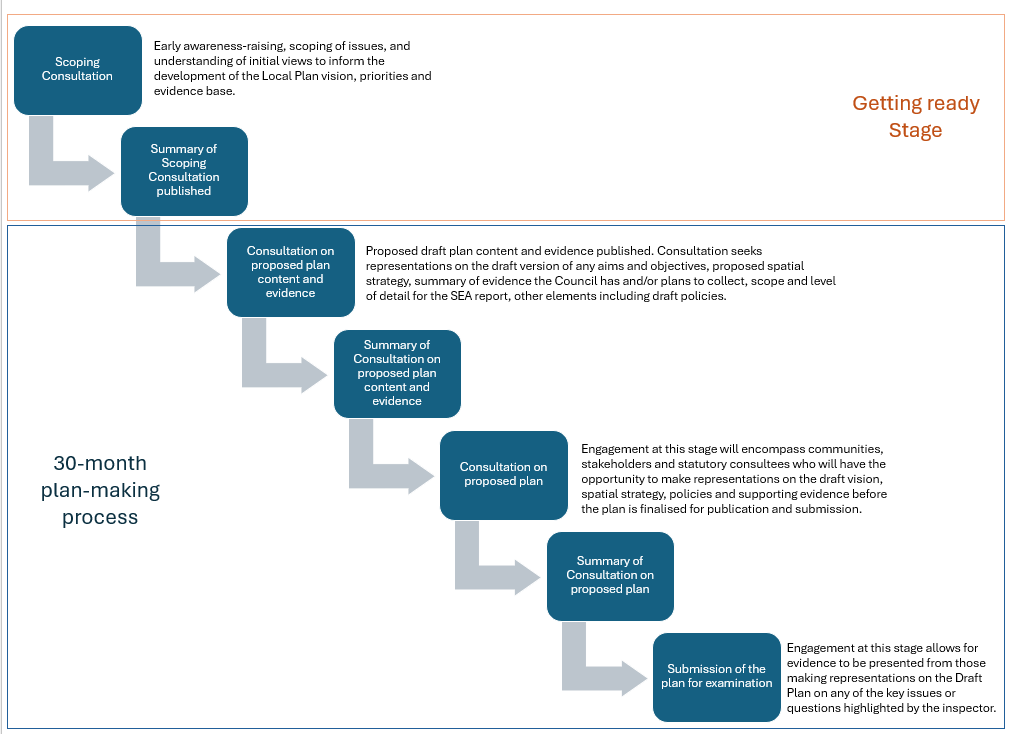
6.2The minimum requirements for consultation and engagement are set out in the Town and Country Planning (Local Planning) (England) Regulations 2026.
6.3At each stage of the local plan development, the consultation and engagement activities will be set out in a summary report. The report will reflect on the activities that have taken place and the issues and opportunities that are emerging, to recommend refinements to consultation and engagement activities for the following stage. It is expected that this summary report could include consideration of:
- the types of groups who should be consulted;
- reflecting on the methods for informing and involving the public; and
- responding to low turnouts at consultation events, or low response rates to consultations.
6.4At the final stage of the local plan process, a ‘Consultation and Engagement Statement’ will be produced, which will summarise and reflect on all the activities that have taken place throughout the plan preparation process and be submitted alongside the ‘Submission Local Plan’ for examination.
7. Baseline Demographic Information
7.1Government guidance suggests that the baseline demographics should be identified and considered when creating and updating the engagement strategy. In 2024, the population of Chichester District[5] was estimated to be 128,934 people, an increase of 5% since 2019, and with a median age of 48 years[6].
7.2The median age in Chichester is projected to rise from 48 years in 2022 to 50 years in 2032; this compares to the predicted median age of 41 years in England. By 2032, it is projected that 30% of the population in Chichester are to be aged 65 years or over, up from 26% in 2022. In contrast, the percentage of people projected to be aged 18 years or under in 2032 is estimated to be 16%, which will be below the average for England of 20%.
7.3It is recognised that engagement during the new local plan preparation should focus on all residents. This includes individuals, seldom heard groups, businesses, communities, and organisations, all of whom make up the population of Chichester. Considering the baseline demographic information of Chichester, it is understood that Chichester has an ageing population and so it is important that the engagement encompasses traditional methods as well as digital.
7.4Furthermore, the north of Chichester is particularly rural, and so it is important to consider the implications for planning and engagement of these rural communities, where digital access and reliance on private transport can influence participation levels. This means that there is a need to consider flexible, hybrid engagement approaches to ensure inclusive engagement.
7.5Appendix 2 expands upon the data set out above, and includes the age, gender, ethnicity, education, identity and household composition of Chichester District. It is important to note that these statistics cover the entirety of the Chichester District including the South Downs. As such, they may not reflect the exact trends across the Chichester local plan area. However, they provide the most accurate representation of the demographics of Chichester as available.
Define target audiences
7.6In order to ensure that we are reaching all demographics within Chichester we will invite people to provide demographic information such as age, gender, ethnic background. These responses will be anonymously used to help understand who is being engaged, and whether further information/work is required to engage with specific underrepresented groups. The privacy notice is being updated to reflect this.
8. Process of engaging a diverse range of stakeholders
8.1Chichester District Council is committed to ensuring that engagement with the local plan is inclusive, accessible and reflective of the diversity of communities across the county.
8.2Planning can be technical, and this can sometimes cause uncertainty. As such, we want to ensure that our consultations are as clear as possible. To do so, we will aim to:
- use plain-English and avoid ‘jargon’ and unnecessary acronyms. We will include a glossary of terms and acronyms and answers to frequently asked questions, where needed;
- carry out consultations at appropriate stages, supported by evidence to help people give informed responses;
- clearly explain how to take part in each consultation and the deadlines for responding;
- promote consultations through a variety of appropriate channels – both digital and non-digital - and hold events or provide information at accessible locations; and
- provide a summary of responses received and explain, where possible, how feedback has been taken into account.
Consultation bodies
8.3Regulation 2 of the Town and Country Planning (Local Planning) (England) Regulations 2026 defines general consultation bodies and specific consultation bodies. A list of these can be found in appendix 3. This section explains how and when these groups, along with councillors and members of the public will have the opportunity to be involved in the local plan process.
Specific Consultation Bodies
8.4Specific consultation bodies are organisations or groups that the council must consult with as part of the statutory requirements. These include neighbouring councils, and agencies such as the Environment Agency, Historic England, Natural England and utility providers.
8.5These groups will be invited to comment at each consultation stage of the local plan process. The planning policy team keeps a database of these bodies and will notify them at each consultation stage.
General Consultation Bodies
8.6General consultation bodies include voluntary groups, organisations representing the interests of different communities, faith groups, and groups representing the interests of disabled people and local business organisations. The council’s database also includes under-represented groups and those who have expressed a desire to be involved in the process, such as agents, developers and landowners, national groups and members of the public.
8.7These bodies will be invited to comment at each stage of the consultation for the local plan. The planning policy team keep a database of these groups and will contact them at each consultation stage.
Ward Member engagement
8.8Ward members will continue to be engaged in the local plan process, and through participation in the following council meetings:
- The council hosts a regular public facing Development Plan and Infrastructure Panel (DPIP). This is an informal panel of members who advise on planning policy and infrastructure planning. The Panel reviews and recommends planning policy documents and infrastructure strategies before they go to the council’s Cabinet and/or Full Council.
- The council’s Cabinet usually meet 11 times per year, and act as the executive arm of the council. Cabinet has the authority to action policies within the plans, strategies and budget approved by the council. Key stages relating to the local plan must be presented to and approved by Cabinet.
- Full Council is made up of all 36 elected councillors. Full Council normally meet six times per year unless a need is identified for any additional meetings. Decisions relating to the local plan must be presented to and approved by Full Council.
- Separate meetings or workshops are sometimes arranged with councillors to discuss specific issues relating to the local plan when required. This may be organised by officers or requested by the member(s).
All councillors will receive additional updates about the local plan process through monthly Members Bulletin email newsletters, media releases, and will be provided with consultation materials to help them explain and promote opportunities for involvement to their constituents.
Members of the Public
8.9Members of the public can speak at certain council meetings, providing an opportunity to share their views during the local plan process.
8.10Members of the public will also be invited to comment on the local plan at the relevant consultation stages.
8.11The planning policy team keeps a database of members of the public who have asked to be kept informed about the local plan and consultations and they will be contacted at relevant points in the process to inform them of the opportunity to share their views.
Digital first approach
8.12In line with national guidance, the council will use a digital-first but not digital-only approach, supported by a range of traditional engagement methods. The digital-first approach can help to encourage feedback from a broad range of ages, provide a strong basis for ongoing engagement, and create meaningful engagement with stakeholders and the wider community. This will help us reach more people and help them engage in the process.
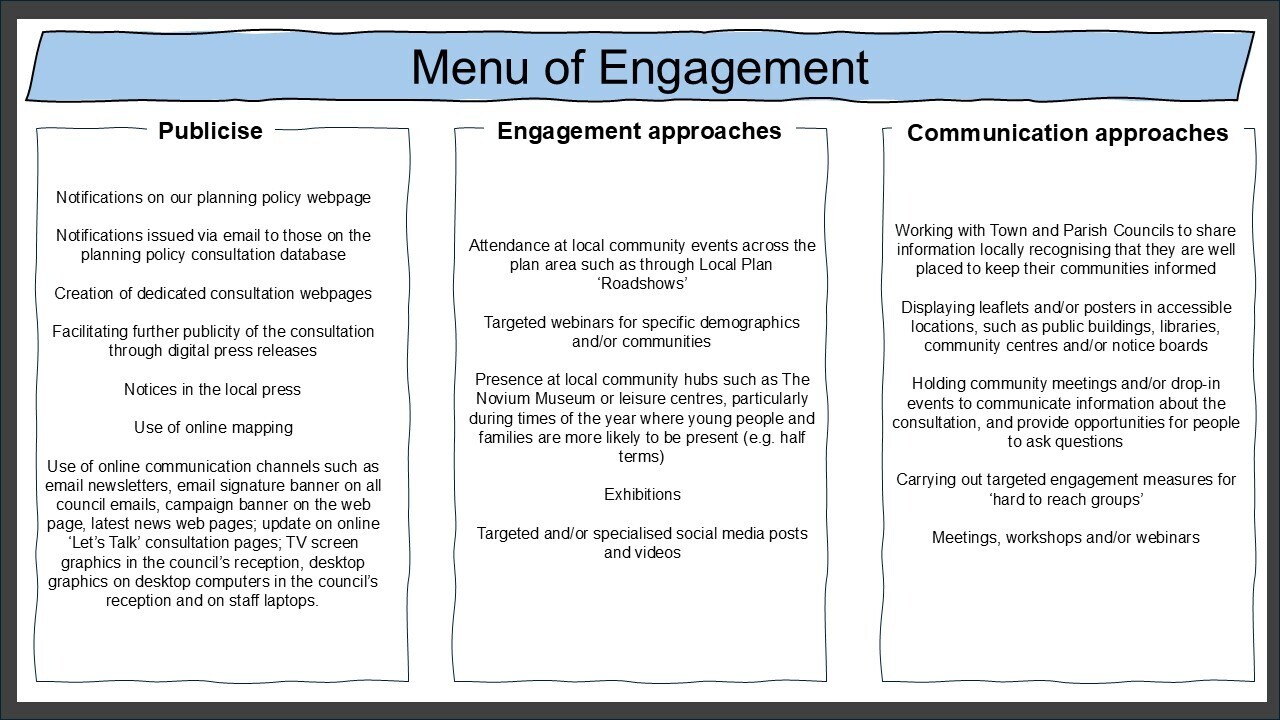
8.13The council will select appropriate methods of publication, engagement and communication from a ‘menu of engagement’ (fig. 2) for each stage of the consultation process.
9. Strategic Cooperation and Cross-boundary working
9.1The legal duty to cooperate, which was introduced by the Localism Act 2011, has now been removed from legislation. This means that it is no longer a legal requirement for LPAs to meet the duty to cooperate. Despite this, there is still a national policy requirement for strategic cooperation within the plan-making process in order for a plan to be found sound. The requirement for cross-boundary working is included in the tests of soundness within the draft NPPF under the following heading:
“Positive – The strategy sets out a positive approach to delivering growth which, as a minimum, seeks to meet the area’s objectively assessed needs, and is based on effective joint working on cross-boundary strategic matters. A strategy which does not provide for objectively assessed needs should be considered an exception, and only where it is evidenced that stringent efforts have been undertaken to meet those needs through cooperation with other strategic planning authorities.”
9.2The council will continue to focus on cross-boundary working to ensure that the local plan is positively prepared. This process is likely to continue to evolve as the local government reorganisation process progresses.
9.3Strategic partners and bodies include (but are not limited to):
- Adjoining local planning authorities (Havant, East Hampshire, Horsham, Waverley, Arun, and South Downs National Park)
- Parish councils (including those which adjoin the district in neighbouring local authority areas)
- Relevant county authorities (West Sussex County Council, Hampshire County Council, Surrey County Council, East Sussex County Council)
- Other local authorities (Adur and Worthing, Lewes, Mid Sussex, Brighton and Hove, Crawley, Portsmouth, Guildford)
- Active Travel England
- Civil Aviation Authority
- Homes England
- Office of Rail and Road
- Transport for South East
- MHCLG
- Integrated Transport Authority
- Transport Infrastructure Management Group
- Water Quality Group
- Sussex and Brighton Strategic Authority
- Environment Agency
- Natural England
- Historic England
- Chichester Harbour Conservancy
- Coal Authority
- Network Rail
- National Highways
- NHS Sussex
- Sussex Police
- Sport England
- Marine Management Organisation
- Relevant electronic communication companies
- Relevant electricity and gas companies
- Relevant sewerage and water undertakers (Thames Water, Southern Water, and Portsmouth Water
Sub-regional engagement
9.4The council attends regular meetings with policy officer groups, and local partnerships, to ensure consistent, effective, and ongoing engagement with relevant bodies.
9.5We will continue to engage and meet with other relevant bodies and groups where necessary during the development of the CLP and evidence base. In addition, the team will regularly meet with other in-council services when necessary.
10. Underrepresented Groups
10.1We recognise that some groups are harder to engage with than others, and traditional consultation methods may not be effective. In some cases, further support may be needed to ensure that we reach as many people as possible and that everyone has the opportunity to get involved. The council will proactively engage underrepresented groups during the preparation of the local plan.
10.2A targeted approach to engagement is the most effective way to engage with underrepresented groups.
10.3Social media can be an important tool to do this as it can be used to target specific demographics including ages and locations. Posts can also be ‘boosted’ to target a wider demographic outside of the council’s own followers.
Underrepresented groups that the council will seek to engage with
Young people
In the past, young people have not been very involved in planning issues. To help with engagement, we will make consultations accessible and available through a number of methods including online and in libraries. Websites will be accessible using mobile accessible webpages. In the future, consultations with this group could be more interactive and engaging, and include working with schools, colleges or community organisations. Engagement could also include attendance of Freshers Fairs at universities, simplified survey style representation forms to distribute to schools, and utilising mobile phone accessible engagement methods.
Ethnic minorities
We will work to engage with people from a wide range of ethnic backgrounds, to keep them informed about the process and to reduce barriers to participation. This will include regularly working with voluntary and community organisations that represent these groups.
Faith communities
We want to ensure that people from different faith backgrounds are also engaged in the planning process. Where possible, we will carry out targeted engagement with faith groups and organisations that represent them.
Disabled people
We will ensure that all community engagement events are fully accessible, and that we respond to accessibility requests in a positive way by providing easy read documents where appropriate. All documents uploaded to the website will be accessibility checked.
Gypsies and Travellers and Travelling Showpeople
We will involve Gypsies, travellers and travelling showpeople, particularly as part of the evidence gathering process. The council has a Gypsy and traveller liaison officer, who can help facilitate effective communication and engagement with these communities. This approach could be used to raise awareness of the consultation, and provide support and guidance on how to get involved.
People living in rural areas
Residents in rural areas, particularly in the north of the plan area, may not have easy access to council offices and may have less access to community events depending on where these are held. Consultation documents will be made available online, as well as in local community libraries and/or buildings to ensure ease of access for both those who have internet access, and those who do not. Advertisements for key consultations will be displayed on local village notice boards, and shared through online newsletters. Any in-person community engagement events will aim to cover the north of the plan area as well as the south to ensure that rural communities are involved.
Renters and Transient Populations (renters, students, temporary workers)
Reaching these communities may involve the use of a broad range of promotion, including on social media. It may also be appropriate to promote consultations in student buildings and Universities.
Digitally excluded people
Consultations will maintain a digital-first but not digital-only approach. Documents will be made available in physical formats at relevant locations including libraries, community buildings and the council offices. Physical consultation response forms will also be available on request. In addition, step-by-step guides to making representations will be provided to those who need additional support in completing online representations.
Lower Income Households
Lower income households may require flexible timings and venues for consultation events, as well as childcare or family friendly timings. The council will do all it can to ensure that consultation events are held at times where lower income households will be able to attend, and provide venues that are easily accessible, local, and appropriate for a range of demographics.
Small scale developers
Consultation with this group may include targeted consultation using the council’s database, creating a targeted list of small-scale developers to engage with.
11. Scoping Consultation Questions
1. Do you agree with the potential engagement methods for each stage of the local plan preparation as set out in Section 9 and Appendix 1 of the Draft Engagement Strategy? If not, what else is needed and why?
2. Do you agree that the potential engagement methods are appropriate to meet the needs of our communities and stakeholders as set out in the demographic profile in Appendix 2 of the Draft Engagement Strategy?
3. Does the document consider all relevant underrepresented groups?
4. Are there any targeted or specific engagement activities that should be considered in engaging underrepresented groups in the plan area?
12. What Happens Next?
12.1Following the scoping consultation, the council will review and consider all the comments received, including feedback on the Draft Engagement Strategy. We will then seek to finalise our engagement strategy which will then be used to assist in the preparation of the local plan going forward.
[1] Statement of Community Involvement
[5] The figures in this section relate to Chichester District as a whole, which includes the part of the district within the South Downs National Park.
