Planning Obligations and Affordable Housing SPD
4. Standard Obligations & Charges View representations
4.1This section sets out how the council will use s106 planning obligations necessary to make development acceptable. A variety of provisions within each s106 obligation may be necessary, therefore the topics covered below are not exhaustive and each development will be considered on a case-by-case basis and in line with relevant, available evidence, guidance, or policies.
4.2For each obligation the threshold and contribution requirements are provided. These are taken into consideration when determining where a proposed development should besubject to planning obligations and to estimate those obligations likely to be required by the council.
Affordable Housing and Market Housing Mix View representations
4.3One of the roles of the District Council is to enable and coordinate the provision of housing including affordable housing, to meet the needs of the community.
4.4The Housing, Homelessness and Rough Sleeping Strategy 2025 – 2030 sets out the aims for the provision of affordable housing. This includes maximising the supply of local homes to meet the needs of local people and ensuring that all new residential development contributes to the supply of homes to meet local needs in terms of size, type and tenure.
4.5The Local Plan Viability assessment considered the total level of developer contributions available to meet the Community Infrastructure Levy, and affordable housing contributions to ensure deliverability of the plan. This assessment informed the level of affordable housing contributions as set out in Policy H4 of the Local Plan. The Local Plan Viability assessment has identified that greenfield sites are capable of accommodating a higher proportion of affordable housing. In addition, it identifies that sites in the north of the Plan Area can accommodate more affordable housing than sites in the south of the Plan Area.
4.6Small sites are considered to be more economically viable, even when the affordable housing contribution and CIL charge is taken into account. In view of the significant need for affordable housing in the rural areas (evidenced by both the Housing and Economic Development Needs Assessment (HEDNA) 2022 and the council's Housing Register) the government's lower threshold in respect of planning obligations introduced on 28 November 2014 has been adopted.
4.7Affordable housing will be sought on all residential development sites of ten dwellings or more, or with an area of 0.5 hectares or more. The proportion sought varies based on the site location and the type of development site. The proportions sought are as follows:
- North of the Plan Area – 40% on greenfield sites, 30% on previously developed land.
- South of the Plan Area – 30% on greenfield sites, 20% on previously developed land.
4.8On sites which comprise areas of both greenfield and previously developed land, the level of affordable housing sought will reflect the proportion of greenfield and previously developed land. For example, on a site of 100 homes in the south of the plan area which is 75% previously developed land and 25% greenfield, the amount of affordable housing that will be required is 22 dwellings.
4.9On sites of 6 to 9 dwellings, in areas designated as rural areas (identified in appendix B to the Chichester Local Plan 2024 – 2039), the council will seek an equivalent financial contribution for the provision of affordable dwellings as a commuted sum towards affordable housing in the District.
4.10The tenure split of the affordable housing should reflect the current HEDNA recommendations as set out in Policy H4 of the Local Plan. Generally, this should be as follows:
- 25% first homes
- 35% social rent
- 22% affordable rent
- 18% shared ownership
4.11It is recognised that it may be appropriate to vary the affordable tenure split where there is suitable and robust evidence demonstrating that a different split would be more suitable, for example where the alternative split would help to address local needs or on smaller sites where it can be difficult to attract registered providers. Applicants are advised to work proactively with the council’s Housing Team in such circumstances.
4.12At the District-wide level, the HEDNA recommends an appropriate mix, size and type of both market and affordable rented housing required on new development. This will be used as the basis for both market and affordable housing requirements over the Local Plan period. Individual sites will be expected to reflect the needs of the HEDNA, subject to site specific circumstances and the character of the local area. Proposals will be required to demonstrate how schemes address local need and demand, and the extent to which development proposals will deliver mixed sustainable communities or a robust justification where such potential has not been optimised.
4.13It is recognised that certain sites, especially small or brownfield sites, may be highly constrained whilst others may lend themselves to particular types of development. Again, such factors will be taken into consideration as part of the appraisal process, although the primary tests of meeting local need and delivering mixed communities will remain in place.
4.14The HEDNA’s recommendation will be considered together with information on local housing need, including the council’s Housing Register, stock turnover and site specific factors to negotiate the provision of affordable housing in new development including the exact tenure, type and size split on each site through pre-application discussions.
HEDNA recommended housing mix by housing tenure and size
|
Tenure |
1 bedroom |
2 bedrooms |
3 bedrooms |
4+ bedrooms |
|
Market |
5-10% |
30-40% |
35-45% |
15-20% |
|
Affordable Home Ownership |
20-25% |
45-50% |
20-25% |
5-10% |
|
Affordable Rented product including both Social and Affordable Rent |
35%-40% |
35%-40% |
15-20% |
5-10% |
4.15The dwelling size and type of intermediate affordable housing (between 20% and 40% of the total affordable housing depending on the site) will be negotiated on a site-by-site basis and assessed on affordability and local need.
4.16The Local Plan area has a disproportionate amount of larger, detached, properties, and this exacerbates affordability issues. The HEDNA has identified that there is a need to maintain a supply of less expensive properties to improve affordability. The mix of market housing should place and emphasis on smaller family homes to help retain younger working households, encourage economic growth and enable older people to downsize.
4.17Applications will be expected to demonstrate how the proposal meets local housing need and demand, help to provide a better mix of size and type of dwelling than currently available and should be supported by robust evidence.
4.18The NPPF requires that eligibility for affordable housing is determined with regard to local incomes, and local house prices. Affordable housing must be affordable to local households whose needs are not met by the market.
4.19The mismatch between local incomes and local house prices creates an affordability gap. A rule of thumb for estimating affordability for average income households is that house prices should not exceed 4.5 times annual household income, to be known as the affordable salary mortgage multiplier.
4.20In the Local Plan area the HEDNA found that median house prices are 14 times the median earnings of those working in the district, and 12.5 times the median earnings of those living in the district. The median earnings of a household in the district was £36,700 and the mean average earnings were estimated at £48,500. Taking the middle ground of these two figures gives a value of £42,600, so the 4.5 multiplier would make an affordable property £191,700. The overall median average house price at September 2021 was £415,000. This evidence clearly points to an affordability gap within the plan area.
4.21The council expects that affordable housing would usually be provided by Registered Providers (RPs) and in most cases by one of its preferred development partners. However, in exceptional circumstances the council may use its discretion to allow other providers approved by the council to deliver affordable housing units, subject to affordability and satisfactory management and allocations arrangements being in place. This will, at all times, be strictly in line with the NPPF, Homes England guidance and the council’s Housing Allocation Scheme requirements.
4.22Homes England requires that the affordable housing provision on market sites is delivered with no public subsidy. In line with Homes England guidance it should be assumed that for Social and Affordable Rent products, the price paid by the Registered Provider will be no more than the capitalised value of the net rental stream of the homes. For affordable home ownership through the shared ownership route, the price paid should be based on reasonable assumptions regarding any rent to be charged on any unsold equity, the likely value of the homes and the initial average share to be offered. In the case of first homes and other discount market value approaches to affordable home ownership, the price paid should represent a significant discount from market value, typically a minimum of 30% discount.
4.23Sections 300 - 302 of the Housing and Regeneration Act 2008 enabled the Secretary of State to designate “Protected Areas”, ensuring shared ownership dwellings are retained as such in areas where they would be difficult to replace. Developers should be aware that all rural parishes within the district are Designated Protected Areas. The council has the ability to request a waiver from Homes England, but will usually only do so in line with the council’s Designated Protected Areas Policy.
4.24Many RPs are unable to take on single affordable housing units and/or deliver shared ownership housing within Protected Areas. The council is committed to delivering mixed and sustainable communities and will seek to deliver both affordable rented and intermediate housing on all sites wherever this best meets local needs. This may include the delivery of Shared Equity or Discount Market sale homes.
4.25If all of the council’s registered provider partners confirm that they are unable to deliver the intermediate dwellings then the owner may dispose of the units to any Council approved provider or purchaser. It is expected that wherever possible the dwellings will be available for occupation as affordable housing at a discounted rate in perpetuity. However, where staircasing to full ownership results in a loss of affordable housing, robust mechanisms will be imposed ensuring that any subsidy is recycled for alternative affordable housing provision in the district. Prior to any sale the Owner or Provider should submit to the council a Market Valuation of the unit(s) undertaken by an independent RICS valuer. Any such model must be approved by the council and clauses relating to the mechanisms of discounted sale model will be included in the section 106 agreement
4.26The affordability formula (the affordable salary: mortgage multiplier) applied to any scheme is calculated by multiplying the district average household earnings by 4.5, which is then divided by the average unit market value of that particular scheme and converted into a percentage for the discount rate.
Example (average earnings)
£42,600 (average earnings) x 4.5 = £191,700 divided by £415,000 (average house price of scheme) x 100 = 46% discount rate. This rate remains with the property and will be applied to future sales.
4.27In order to prevent social exclusion and to help establish a mixed, balanced and sustainable community within large developments, it is very important that the affordable housing is well integrated and distributed throughout the site. The affordable units should be appropriately clustered in dispersed small groups, no more than 15 units on strategic sites as identified in the local plan and no more than 10 units on all other sites. Affordable housing and its setting should not be externally distinguishable from the market housing in line with Commission for Architecture and the Built Environment (CABE) recommendations.
4.28The affordable dwelling units must as a minimum meet or exceed the nationally described space standards (or any subsequent standards). They should also meet or exceed the core requirements set out in the Homes England advice “Healthy Homes – a foundation for healthier and resilient communities”[2].
4.29To ensure the timely delivery of affordable housing, a s106 will usually include a phasing plan or a clause requiring a number of affordable dwellings to be completed as part of each phase, or to be all completed before the market housing can be occupied.
4.30Affordable housing grant funding is generally not available for the affordable housing contribution on a market site. However, where there are viability issues which result in the full affordable housing quota not being deliverable, the developer will be expected to exploit any possibility of securing grant funding to enable delivery of the full affordable housing quota.
4.31Where government grant funding is not available, delivery of the full affordable housing quota in an alternative mix to that recommended by the HEDNA may be considered. Only as a last resort, and usually following an independent viability report, will a reduced affordable housing contribution be accepted.
Affordable Housing Financial Contributions View representations
4.32On all residential development sites where there is a net increase of 10 or more dwellings the council will require affordable housing to be provided on-site, this includes all sheltered, extra-care and assisted living schemes which fall within use class C3. A financial contribution of broadly equivalent value will only be accepted in exceptional circumstances where it can be robustly justified, and the agreed approach contributes to the objective of creating mixed and balanced communities.
4.33Where the proportion of affordable housing results in a requirement for a fraction of a unit, the fraction will be sought as a financial contribution (in the form of a commuted sum). In determining whether affordable housing should be provided on a site the council will consider the suitability of the site in terms of its proximity to services, facilities and public transport as well as viability and any constraints which restrict the layout and ability to provide the full housing requirements on site.
4.34Commuted sum payments in lieu of on-site affordable housing provision will be the default requirement for all applicable residential development proposals which result in a net addition of 6-9 dwellings. Also, where it can be demonstrated that design constraints or other justifiable factors make it impossible to provide affordable housing onsite.
4.35As part of the Local Plan 2021-2039 viability testing, Dixon Searle Partnership (DSP) reviewed the mechanism to calculate off-site financial contributions in lieu of on-site affordable housing that was introduced in February 2016 when the previous version of this document was adopted.
4.36DSP supports the existing model, which is broadly aligned with CIL principles and is calculated on a square metre basis of Gross Internal Floor Area (“GIA” as defined by RICS guidance to include internal communal corridors and means of access but excluding non-saleable rooms within special need proposals, e.g. sheltered or extra-care schemes). It secures broadly equivalent financial contributions to the cost of providing onsite affordable housing, provides transparency and ensures financial viability taking account of CIL charges and local standards in the Local Plan.
4.37Applying the same tests and development typographies that informed the proposed CIL charging schedule, DSP advised that to reflect the approach taken in policy H4, variable rates should be applied.
|
Site location |
Site type |
Adopted rate |
Equivalent to |
|
South of plan area |
Greenfield |
£400 |
30% affordable housing |
|
Previously developed land |
£260 |
20% affordable housing |
|
|
North of plan area |
Greenfield |
£660 |
40% affordable housing |
|
Previously developed land |
£500 |
30% affordable housing |
Calculating Affordable Housing Financial Contributions
4.39Gross financial contributions will be calculated using a rate per square metre of the total Gross Internal Floor Area of all net additional dwellings (either new-build or conversions). The rates are summarised in the table at paragraph 4.39 above.
Example 1
An eligible development on a greenfield site in the south of the plan area comprises 3 x market houses @ 100 square metres GIA and 3 x market houses @ 85 square metres GIA.
Total GIA = 555 Square Metres x £400 = £222,000 financial contribution in lieu of on-siteaffordable housing.
Example 2
An eligible development on a previously developed site in the north of the plan area comprises 5 x market houses @ 140 square metres GIA.
Total GIA = 710 Square Metres x £500 = £355,000 financial contribution in lieu of on-site affordable housing.
4.40Where a development comprises both previously developed and greenfield land, the financial contribution will be calculated using a proportionate approach.
Example 3
An eligible development in the south of the plan area comprises 8 market houses @ 100 square metres GIA. 75% of the site is previously developed land and 25% is greenfield.
Total GIA = 800 Square Metres
75% charged at previously developed rates = 600 sqm x £260 = £156,000
25% charged at greenfield rates = 200 sqm x £400 = £80,000
£236,000 financial contribution in lieu of on-site affordable housing.
Calculating Partial Affordable Housing Financial Contributions
4.41A partial financial contribution as well as on-site affordable housing provision will be required in situations where on-site calculations result in less than a whole unit of affordable housing e.g. where a proposal for 11 units is required to provide 30% affordable housing on-site (3.3 units).
The calculation will require two stages:-
Stage 1: Calculating the eligible GIA
Eligible GIA = Total GIA x Policy Percentage of Affordable housing
Stage 2: Calculating the Affordable Housing GIA shortfall
GIA Affordable Housing Shortfall = Eligible GIA – Total GIA onsite Affordable Housing
Financial Contribution for GIA Affordable Housing Shortfall (if greater than zero) = GIA Affordable Housing Shortfall x Applicable Rate for AH Commuted Sum
Example
An eligible greenfield development in the north of the plan area comprises 2 x houses @ 100 square metres, 4 x market houses @ 90 square metres, 2 x market @ 80 square metres GIA (total 720 square metres) and 1 x affordable housing unit @ 85 square metres, 2 affordable housing units @ 80 square metres (total 245 square metres).
Eligible GIA (720 + 245) x 30% = 289.5 square metres
GIA Affordable Housing Shortfall (289.5 - 245) = 44.5 square metres
Financial contribution for GIA Affordable Housing Shortfall (44.5 x £650) = £28,925.
Spending Affordable Housing Financial Contributions
4.42Off-site financial contributions for affordable housing will be 100% ring-fenced for housing expenditure that results in housing needs being met within the District.
4.43The allocation and expenditure of commuted-sum payments will be agreed and authorised by an appropriate Council Committee. As part of the approval process it must be demonstrated that:
- Value for money will be achieved;
- That any proposed forms of spending will result in preserved subsidised affordable housing in the long-term or,
- Steps will be taken to ensure the recycling of capital subsidy and associated financial gain, should any of the subsidised affordable housing be lost to the open market.
4.44Part of the contributions collected may be used to off-set the costs of officer post(s)required to enable the delivery of affordable housing within the plan area.
Vacant Building Credit View representations
4.45Subject to certain conditions, paragraph 65 of the NPPF (2024) requires that where vacant buildings are being reused or redeveloped, any affordable housing contribution that is due should be reduced by a proportionate amount, equivalent to the existing gross floorspace of the existing buildings.
4.46This means that where a development only involves bringing a vacant building being back into use (or an equivalent amount of new development following the building’s demolition), no affordable housing contribution should be sought; on other sites where there is an increase in overall floorspace as a result of development, the level of affordable housing sought should only reflect the additional floorspace that is created.
Example 1, onsite provision on a 100% previously developed site
A development on a previously developed site in the south of the plan area proposes 500 dwellings @ 100 square metres GIA. The internal floorspace of existing vacant buildings on site totals 20,000 square metres of internal floorspace.
Total GIA = 50,000 square metres
Vacant building credit (20,000/50,000) = 40%
The amount of affordable housing to be sought should therefore be reduced to 60% of the normal amount.
The requirement for a site of 500 homes on a previously developed site in the south of the plan area would usually be 20% of the homes on site i.e. 100 homes. Applying vacant building credit would reduce the requirement to 60 affordable homes.
Example 2, financial contribution on a 100% previously developed site
An eligible development on a previously developed site in the north of the plan area comprises 5 x market houses @ 150 square metres GIA. The internal floorspace of an existing vacant building on site is 188 square metres GIA.
Total GIA = 750 Square Metres x £500 = £375,000 financial contribution in lieu of on-site affordable housing.
Vacant building credit (200/750) = 25%
Applying vacant building credit results in a 25% reduction to the financial contribution sought, resulting in the financial contribution in lieu of on-site affordable housing being £281,250 after vacant building credit is taken into account.
4.47On development sites where there is a mix of previously developed and greenfield land, the council will apply the vacant building credit on a proportionate basis, in line with NPPF paragraph 65’s stated objective that vacant building credit should support the re-use of brownfield land.
Example 3, onsite provision on a site where 60% of the development is previously developed land
A development in the south of the plan area proposes 300 dwellings @ 100 square metres GIA. 60% of the total site area is previously developed land. The internal floorspace of existing vacant buildings on site totals 10,000 square metres of internal floorspace.
Total GIA = 30,000 square metres
18,000 sqm, or 180 dwellings, are assessed at “previously developed” rates and is eligible for vacant building credit. The other 12,000 sqm (120 dwellings) is assessed at “greenfield” rates, and no vacant building credit is applied.
Vacant building credit (10,000/18,000) = 56%
The amount of affordable housing sought from the 180 houses associated with the previously developed land should be reduced to 44% of the normal amount..
The requirement for the 180 homes would normally be 20% i.e. 36 dwellings. Applying vacant building credit would reduce the requirement to 15 affordable homes.
The affordable housing for the 120 houses associated with the greenfield land should provide a policy-compliant level of affordable housing. In the south of district this would be 30% i.e. 36 dwellings.
The site as a whole would provide 51 affordable homes, or 17% of the overall dwellings on the site.
Example 4, financial contribution on a site where 50% of the development is previously developed land
An eligible development in the north of the plan area comprises 5 x market houses @ 150 square metres GIA. Half of the site is previously developed land and the rest is greenfield land. The internal floorspace of an existing vacant building on site is 188 square metres GIA.
Total GIA = 750 Square Metres
375 sqm is assessed at “previously developed” rates and is eligible for vacant building credit. The other 375 sqm is assessed at “greenfield” rates, and no vacant building credit is applied.
375 x £500 = £187,500 financial contribution in lieu of on-site affordable housing and eligible for vacant building credit
Vacant building credit (188/375) = 50%
After applying vacant building credit, the financial contribution for the previously developed land is reduced to £93,750
The greenfield portion of the site is assessed as 375 sqm x £660 = £247,500 financial contribution
The total financial contribution in lieu of on-site affordable housing is £341,250.
4.48Vacant building credit does not apply to buildings whose use has been abandoned. Additionally, the council will not apply vacant building credit when the building has become vacant for the sole purpose of redevelopment.
4.49Vacant building credit does not affect the calculation of CIL, and will not result in a reduction of the amount of CIL that is due from a development. This is because the CIL regulations include their own mechanism for accounting for the demolition or reuse of existing floorspace as a part of a proposed development.
Affordable Housing Exception Sites View representations
4.50Local Plan: Policy H7 sets out the council’s approach for rural exception sites and first homes exception sites, aimed at providing affordable housing to meet specific, local needs. Planning applications must be accompanied by satisfactory evidence, which demonstrates that the scale and mix of housing proposed will meet a local need. This should be based on information from the council's housing register or from an up to date parish housing needs survey that has been produced by or on behalf of the council and in partnership with the Parish Council.
4.51To ensure deliverability, applicants need to provide evidence that their proposals are economically viable. Due to their location, exception sites should be owned and managed by an approved Registered Provider, Community Land Trust or other Community Led Housing Group.
4.52Exception sites must provide affordable housing in perpetuity; consequently, the units must be secured through s106 with an accompanying Nomination Agreement with the Registered Provider that provides the nomination criteria for the homes. This also relates to any intermediate housing, including Shared Ownership and Low Cost Home ownership. Full ownership and future sale of such units on the open market will not usually be permitted unless it can be clearly demonstrated that open market sales are necessary to enable the delivery of affordable homes.
4.53First homes exception sites must primarily deliver first homes, and these sites must similarly provide first homes in perpetuity, which will be secured through s106. Applicants will need to demonstrate a that there is an unmet need for first homes that is not addressed elsewhere in the plan area, and first home exception sites should be located adjacent to or as close as possible to an existing settlement boundary. First homes exception sites will not be permitted in areas designated as ‘rural’ under Section 157 of the Housing Act 1985, the AONB, or in a National Park.
4.54A particular feature of exception site development is the constrained land value that results from affordable housing usage, when open market land values would render subsidised housing undeliverable and financially unviable. Given the increasing difficulty in securing public subsidy for such schemes, the successful delivery of affordable housing is likely to depend upon very low land values, as close as possible to agricultural values.
4.55Only in exceptional circumstances will an element of market housing be allowed, subject to a robust justification in order to cross-subsidise the affordable housing or first homes.
First Homes / Discount Market Value Units View representations
4.56First Homes were introduced as a form of affordable housing in the written ministerial statement dated 24 May 2021. Policy H4 of the Local Plan 2021-2039 sets out that 25% of affordable housing on qualifying developments should be provided as First Homes.
4.57First homes must be discounted by a minimum of 30% against market value, the first sale price must be no higher than £250,000 and the First Home must be sold to a person who meets the eligibility criteria. A S106 agreement will be entered into to secure the necessary restrictions on the use and sale of the property.
4.58The minimum discount for First Homes is 30% of market value, which will be set by an independent registered valuer. The valuation should assume the home is sold as an open market dwelling without restrictions.
4.59The level of discount will be secured both within a section 106 legal agreement and on the title at HM Land Registry to ensure that the discount is applied on future sales of the property.
4.60The minimum 30% discount will be monitored and reviewed to ensure that homes remain affordable for local households in perpetuity.
First Homes Eligibility
4.62Local connection restrictions will apply on the sale of First Homes. Purchasers must evidence that they are a permanent resident, or permanently employed (more than 16 hours) or have a parent, sibling, or child permanently resident within Chichester District.
4.64Members of the Armed Forces, the divorced or separated spouse or civil partner of a member of the Armed Forces, the spouse or civil partner of a deceased member of the Armed Forces (if their death was caused wholly or partly by their service) or veterans within five years of leaving the Armed Forces will be eligible to purchase a First Home. Armed Forces personnel will be exempt from the local connection requirement.
4.65First Homes are intended to be used as a person’s sole or primary residence. However, it is recognized that there are occasions when it may be necessary for owners of First Homes to let out their property for short periods of time, especially in response to unexpected life events. Therefore in certain circumstances, the owner of a First Home can rent out their home for a maximum period of two years, as long as the local housing authority is notified.
Custom and Self-Build Housing View representations
4.66The Self-build and Custom Housebuilding Act 2015 (as amended by the Housing and Planning Act 2016) requires the council to keep a register of individuals and associations of individuals who are seeking to acquire serviced plots of land in the plan area. The council must grant permission for enough suitable serviced plots of land in order to meet the demand within 3 years of the end of each base period.
4.67Local Plan Policy H6 sets out that on sites of more than 200 dwellings, 5% of market units should be custom or self-build. Custom and self-build plots are encouraged on other sites, such as neighbourhood plan site allocations.
4.68Custom and self-build plots must be extensively marketed for at least twelve months, prioritising those who are on the council’s Custom and Self-Build register.
4.69Custom and self-build plots on a development site will be secured through a section 106 agreement, together with the formal marketing requirements and any local connection test or prioritisation that applies.
Transport and Highways View representations
4.70The Infrastructure Delivery Plan identifies a package of coordinated transport measures that are needed to mitigate the traffic impacts resulting from housing and other development proposed in the Local Plan. This includes improvements to the local junctions on the A27 Chichester Bypass, targeted improvements to the local road network, improved public transport, cycling and pedestrian routes, and 'Smarter Choices' promotional measures aimed at encouraging behavioural change towards more sustainable modes of travel. It is envisaged that these measures will be funded through a combination of contributions obtained through planning obligations (s106 and s278 agreements), CIL, grants (where available) and direct investment by the Local Highways Authority.
4.71Most developments generate new transport movements. In the case of many development schemes, specific works and improvements will be required either on-site or off-site to mitigate the direct impact of the development scheme on the transport network and to make the proposed development acceptable, for example improvements to junctions, provision of traffic signals, traffic calming, walking and cycling measures, public transport enhancements, etc. These can be described as development specific transport works and are normally required to be implemented as part of the development scheme.
4.72Obligations will be sought where there are requirements to improve access to non-carinfrastructure in order to access development in a safe and appropriate manner or to mitigate the effects of the development on the transport network.
Mitigating the impact of development on the A27 Chichester Bypass View representations
4.73The A27 is part of the Strategic Road Network and is therefore the responsibility of National Highways. All new housing development proposed in the Local Plan will generate additional traffic impacts on the A27 Chichester Bypass junctions and the associated local highway network which will require mitigation to ensure that the traffic growth as a result of new housing developments does not result in unacceptable road safety risks or is otherwise severe.
4.74Policy T1 makes provision for a coordinated package of transport measures and infrastructure improvements, including the potential for those to junctions on the A27 Chichester Bypass, within the city and elsewhere that will increase modal choice, reduce the need to travel by car, improve safety and air quality, and improve access to Chichester city from surrounding areas.
4.75This includes the provision of a monitor & manage framework to ensure envisaged mitigation outcomes are properly targeted and effective. This includes developing and maintaining a further transport evidence base, refining and prioritising a suite of transport mitigation measures, and monitoring the effectiveness of existing and implemented measures. A Transport Infrastructure Management Group (TIMG) has been formed to recommend on the management, assessment, prioritisation, funding and delivery of strategic and local schemes identified, including further mitigation necessary in response to monitoring.
4.76The ‘Total Funding Requirement’ for the mitigation measures set out in the Chichester Local Plan 2021-2039 and the Chichester Transport Study 2024[3] is up to £120,530,000.
4.77The Chichester Local Plan 2021-2039: Viability Assessment - Stage 2 (DSP, January 2023) identified that the majority of development typologies across the south of the District are sufficiently viable to support a contribution level of up to £8,000 per dwelling. This therefore represents the upper threshold of the ‘Target Contribution Level’ for development to contribute to the transport mitigation funding requirement in the south of the plan area. This is the starting point against which other factors, such as the location of development and the size of the dwelling (i.e. likely level of car ownership) can be applied, to ensure that the financial contribution applied to development is fairly and reasonably related in scale and kind.
4.78Contributions for the A27 Chichester Bypass mitigation are then calculated using an apportionment methodology which is based on up-to-date information from the following sources:
- Census - household and car ownership data;
- Car ownership forecasts; and
- Available transport data, including origin destination trip data
4.79The methodology first determines a factor at ward level that is based on car ownership. Car ownership is used as a proxy for likely car trips and it is expected that in addition to dwelling size influencing car ownership, this will also be influenced by site proximity to a good range of amenities or good sustainable transport links. Lower car ownership results in a lower per dwelling contribution.
4.80Transport data is then used to determine the likely impact of dwellings on the A27 Chichester Bypass. This data has been used to determine the number of trips from each site (combined at ward level) that reach the A27 Chichester Bypass. This includes trips which may only cross over the A27 at one of the six junctions, as well as those that travel along the bypass.
4.81The outcome of this is a ward level matrix which provides an ‘Apportionment and Averaging Factor’ for each of the 14 wards south of the South Downs National Park.
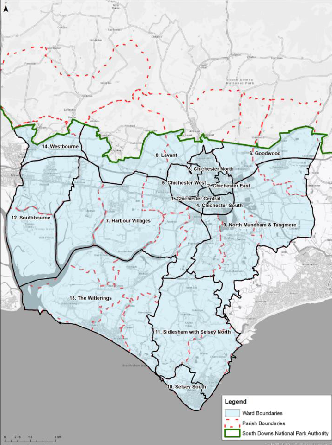
4.82The relevant Apportionment and Averaging Factor is then multiplied by the Target Contribution Level (£8,000) for each dwelling to derive the contribution for that dwelling.
4.83To ensure that contributions collected by the council for the purposes of mitigating the impact of development on the A27 continue to be fairly and reasonably related in scale and kind, the council will publish and maintain an up-to-date matrix of the apportionment and averaging factors on its website[4], taking account any changes required through the application of updated or more relevant data to the apportionment methodology. Through the monitor and manage process, the council will also provide any necessary update to the Target Contribution Level, as a result of changes to the Total Funding Requirement.
4.84Section 106 agreements will be used to require developers to provide mitigation for the A27. On the grant of planning permission, the council will include a clause in a s106 agreement requiring that, prior to commencing any housing construction, the developer will make provision for a specified financial contribution, which will be based on the relevant cost per dwelling set out on the council’s website.
4.85It is important to recognise that the guidance within this SPD is based upon typical car ownership and travel patterns, and there may be instances where a an alternative evidenced approach would be appropriate as an alternative. Applicants are therefore advised to check with the council regarding the level of A27 mitigation contributions that will be required for any given proposal, either during pre-application engagement or following submission of a planning application.
4.86The A27 mitigation contributions will apply only to any net increase in new dwellings coming forward in the area to the south of the National Park (see Appendix 1). The contribution will be sought from all new dwellings, including from affordable homes, retirement homes (such as sheltered housing) and from self or custom-build homes.
4.87If a development involves the demolition of any dwellings or the conversion of a larger dwelling into multiple smaller dwellings, the total contribution for the dwellings to be lost can be calculated and deducted from the overall contribution for the development as a whole. The overall contribution for the development cannot fall below zero.
4.88There are some cases where the A27 mitigation contributions are unlikely to be sought or there may be reasons for a reduced contribution based upon evidenced lower car ownership. Where applicants are in doubt, they are advised to ask about this during pre-application engagement with the council.
4.89For accommodation (whether a building or caravan) where the planning permission is for short-term holiday lets, it would not be appropriate to apply the contribution as this could result in double-counting the impact on the A27, to the extent that those using the lets may live within the south of the District. In addition, there is no viability evidence to support applying a financial contribution to the delivery of holiday accommodation
4.90The A27 junction measures identified in the Local Plan are designed only to mitigate the impact of the development proposed in the Plan. While the government has made it clear that there is no prospect of improvements to the A27 within Chichester through the nationally administered Road Investment Strategy (RIS) in the foreseeable future, should National Highways bring forward a scheme for A27 improvements in the future there may be a need to coordinate the Local Plan measures with National Highways proposals.
County Highways and Other Travel Measures View representations
4.91West Sussex County Council is the Local Highway Authority for the Chichester Local Plan area. Chichester District Council consults West Sussex County Council on planning proposals that affect the highway network. West Sussex County Council provides advice on the scope of obligations for transport infrastructure works and measures where it is considered there is a need to mitigate the impact of new development on the transport network. A range of transport measures may be required as a result of individual schemes. The main types of obligations are likely to be:
- Travel Plans - A Travel Plan is a package of measures to reduce car travel to and from a proposed site, and to encourage the promotion of more sustainable forms of transport by increasing the awareness of travel options, such as walking and cycling, and through the provision of facilities to support such options. Travel Plans should include targets for the reduction in travel related impacts and include resources for supporting and maintaining the travel plan. Travel Plans are likely to be secured via planning conditions on most sites, but may require a planning obligation on larger or more complex development proposals;
- Works required to secure safe access and egress from the development site to the adjoining highway network or to mitigate the direct impact of the development on the off-site road network;
- Provision of internal roads to adoptable standard; Site-specific pedestrian and cycle facilities;
- Site-specific measures to improve public transport services and facilities;
- The provision, removal or relocation of street furniture; dropped kerbs; pedestrian crossings; traffic lights; signage; or trees;
- Contributions to car clubs; and
- Contributions to low emission vehicle infrastructure.
4.92Provision for on-site facilities can be made through planning conditions and a s38 or s278 Agreement under the Highways Act 1980, and they may also be secured through a s106 planning obligation. As mentioned earlier, s278 Agreements are not the responsibilityof Chichester District Council as Local Planning Authority, but are the responsibility of West Sussex County Council as the Local Highway Authority, or in the case of a trunk road, National Highways. Further guidance on s278 can be found on their respective websites.
Education View representations
4.93Education facilities are assessed by West Sussex County Council which provides the necessary information to the District Council as referenced in the Infrastructure Delivery Plan. Education facilities required in respect of the wider growth of the area may be funded in part or in whole through developer contributions. Contributions are usually sought for primary school, early years, and Special Education Needs and Disabilities (SEND).
4.94Where the on-site provision is required to support a new site allocation the council will expect the developer to provide the land for the facility and either design and build the provision to the satisfaction of the council or make a financial contribution to the council so that it may arrange for the construction and development of the required facility.
4.95Indicative costs are set out below. Developers are encouraged to discuss specific proposals with the County Council’s Education team.
|
1 Form Entry Cost |
2 Form Entry Cost |
3 Form Entry Cost |
|
|
Primary School (4 to 11 years) with early years, special support centres and SEND provision |
£8.27m |
£15.11m |
£20.22m |
(1) Source: WSCC 2026
4.96The guideline land requirements for new primary school sites are set out in the table below:
|
1 Form Entry |
2 Form Entry |
3 Form Entry |
|
|
Area of land required for Primary School (4 to 11 years) including early years, special support centres and SEND provision |
1.2 ha |
2.1 ha |
3.1 ha |
(1) Source: WSCC 2026
4.97Further information can be found in “Planning School Places”, published by West Sussex County Council[5].
Public Open Space and Sport and Recreational Facilities View representations
4.98The Local Plan area is deficient in the provision of all types of open space. Policy P15 therefore seeks to retain all open space unless an equivalent replacement can be provided in terms of quantity, quality and accessibility.
4.99New and improved public open space is required to continue to serve the growing population of the area. In accordance with the Local Plan 2021-2039, the council will seek to deliver a network of open space through maximising opportunities for new public accessible open space linking to a network of Green Infrastructure.
4.100The Open Space, Sport and Recreation Study 2024 established new minimum quantity, quality and access standards for different types of open space (as set out in the table below) in the Chichester Local Plan area. It established a local minimum standard open space provision of 3.5 ha per 1,000 people. Any land required for parking, access or built facilities are in addition to thestandards. Parking for built provision will be calculated based on West Sussex County Council Parking Standards and Transport Contributions Methodology Supplementary Planning Guidance. The standards for each typology are set out below:
Minimum open space quantity and access standards
|
Typology |
Minimum quantity standards in hectares per 1000 population |
Access standard |
|
Allotments |
0.30 ha |
600 metres or 12-13 minutes |
|
Amenity Green Space(3) |
0.65 ha |
600 metres or 12-13 minutes |
|
Parks, Sport and Recreation Grounds(1) |
1.2 ha |
600 metres or 12-13 minutes |
|
Equipped Play Space (Children)(2) |
0.075 ha |
480 metres or 10 minutes |
|
Equipped Play Space (Youth)(2) |
0.075 ha |
720 metres or 15 minutes |
|
Accessible Natural Green Space |
1.2 ha |
720 metres or 15 minutes and Natural England’s Accessible Natural Green Space Standards and Woodland Trust’s Woodland Access Standard |
|
Total for new provision |
3.5 ha per 1000 population |
|
|
||
4.101The table below shows the average household size, based on the 2021 census. This should be used for calculating the amount of on-site provision required by open space type. The council will update occupancy rates as appropriate with the latest available census data.
Average household size
|
Dwelling Size |
Average Household Size (Census 2021) |
|
1 Bedroom |
1.3 |
|
2 Bedroom |
1.9 |
|
3 Bedroom |
2.3 |
|
4+ Bedroom |
2.8 |
4.102If competing priorities mean that open space is to be provided off-site, provision may be made through alternative sources such as the Community Infrastructure Levy (CIL). The thresholds for on-site open space, sport & recreation facilities to be secured by S106 is set out in the table below.
Threshold requirement for open space, sport and recreation facilities
Threshold requirement for providing on-site open space, sport & recreation facilities to be secured by S106
Type of provision
1-19 dwellings
20-49 dwellings
50-99 dwellings
100+ dwellings
Allotments
Not required
Not required
Not required
Must be provided
Amenity and Natural Green Space
Not required
Must be provided
Must be provided
Must be provided
Parks, Sport and
Recreation Grounds(1)
Not required
Not required
Not required
Must be provided
Equipped Play Space (Children)
Not required
Not required
Must be provided
Must be provided
Equipped Play Space (Youth)
Not required
Not required
Not required
Must be provided
Small community and sports halls(2)
Not required
Not required
Not required
May be required
- For sports pitches, facilities need to be provided according to the need identified in the most up to date Playing Pitch Strategy.
- Provision depends upon average household size; local circumstances and quantity and access standard.
4.103Where facilities are to be provided on-site, the council will expect the developer to provide the land for the facility and either design and build the provision to the satisfaction of the council in compliance with National Governing Body, Sport England Guidance or Play England Design for Play Guidance or make a financial contribution to the council so that it may arrange for the construction and development of the required facility. All housing types are expected to contribute with the exception of housing for the active elderly which is not /expected to make provision for equipped play space.
Maintenance contributions for open space
4.104Where a development is required to provide open space on-site, the developer is expected to maintain the open space during a defect period of at least 1 year. Developers will then be required to maintain the new provision in perpetuity either directly or through a management company and/or third party.
Built facilities
4.105Sports fields and pitches should be accompanied by the provision of small built facilities to accommodate toilets, showers and changing rooms, and associated parking and access commensurate with the scale of development proposed.
4.106Where Community Halls are required to be provided on-site the following quantity and access standards will apply:
Built sport and recreation facilities quantity and access standards
Indoor Facility
Quantity Standard
per 1000 population
Access Standard
Drive-time or walking in urban areas
Indoor sports facilities
See the Indoor and Built Sport and Leisure Facility Needs Assessment
No standard set
Small community halls*
New housing developments generating 500 or more people will be assessed by the council to determine what facilities are required proportionate to the scale of development proposed.
The standard will be applied flexibly to best meet local circumstances. The aim should not be (for example) to create a proliferation of small community venues in areas of growth where fewer larger venues would be more appropriate. Contributions arising from this standard may also be used towards the enlargement/improvement of existing venues (whether on-site or nearby off-site) where appropriate.
A small community hall will be required to provide:
A main hall to be used for a variety of recreation and social activities, of at least 18m x 10m; a small meeting/committee room; kitchen; storage; toilets; provision for disabled access and use; car parking.
Overall a total net floor space of 300 sqm will be used as a minimum guide for the building.
A larger hall will be needed where an identified need for badminton or other sports and health and fitness facilities as local needs determine.
600 metres or 15 minutes straight line walk time, but 15 minutes drive-time might be acceptable in rural areas.
* Sports Halls and Health and Fitness facilities can be provided in small community halls as local needs determine – so applied flexibly.
Site Specific Historic Environment
4.107The requirements will depend on the nature of the development proposal. However, it may be relevant to any listed building, development in a conservation area, or an area of known archaeological potential.
4.108Where appropriate the following may be included as s106 planning obligations in relation to heritage assets:
- Repair, restoration or maintenance of heritage assets.
- Production and implementation of conservation management plans.
- Increased public access and public open days.
- Provision of signage, interpretation panels and accessible information.
- Dissemination of historic environment information.
- Recording of archaeological remains published appropriately and placed on the Historic Environment Record (HER).
- Measures for the preservation in situ of archaeological assets, or in certain circumstanceswhere it is deemed necessary to excavate.
Site Specific Flood Risk View representations
4.109Policy NE16 requires all development to ensure that, as a minimum, there is no net increase in surface water run-off. Priority should be given to incorporating Sustainable Drainage Systems (SuDS) to manage surface water drainage, unless it is proven that SuDS are not appropriate. Where SuDS are provided arrangements must be put in place for their whole life management and maintenance. These may be secured through a planning obligation.
4.110Where a development is likely to have an impact on flood risk, such development must take account of the South East River Basin Management Plan, relevant Surface WaterManagement Plans, Catchment Flood Management Plans and related flood defence plans and strategies. Financial contributions may be required where development on a site needs to utilise these measures to mitigate a direct impact of the development.
Site specific Habitats Regulations Assessment measures View representations
4.111Policy NE8 require appropriate avoidance/mitigation measures, for applications within the 5.6km ‘zone of influence’ of Chichester and Langstone Harbour, and within the 3.5km ‘zone of influence’ for Pagham Harbour or where required for residential schemes that fall outside the zones where mitigation is deemed necessary as identified in the Local Plan 2021-2039. This is because both sites are statutorily protected sites under the Conservation of Habitats and Species Regulations (2017) (as amended), and recreational disturbance is an issue that needs to be addressed.
4.112Where planning proposals are required to provide on-site mitigation and management measures, these must be agreed by Natural England.
4.113Off-site access management mitigation will be funded from S106. Developments within the zone of influence of Chichester and Langstone Harbours pay a sliding scale contribution based on the number of bedrooms, which is used to fund a package of wardening, education, green infrastructure improvements and monitoring. The contribution amount, as of 1 April 2025, equates to an average rate of £805 per net additional dwelling. The scale of contributions differs according to the number of people expected to live in the property which is calculated per bedroom. The contributions rates for Bird Aware Solent are currently:
|
Number of bedrooms |
Contribution per dwelling |
|
1 bedroom |
£482 |
|
2 bedrooms |
£696 |
|
3 bedrooms |
£907 |
|
4 bedrooms |
£1,067 |
|
5 or more bedrooms |
£1,251 |
|
Flat rate* |
£805 |
* The flat rate typically applies in cases of caravans, tents or gypsy and traveller sites, where the number of bedrooms is not determined by the permission.
4.114These figures will be increased on 1 April each year in line with the Retail Price Index (RPI, currently a 3.6% increase for 25/26) rounded to the nearest whole pound. Where the number of bedrooms is not fixed by the permission (e.g. tent or caravan pitches) the flat rate contribution amount, currently £805, will be used. The revised rates may be found on the council’s website at: https://www.chichester.gov.uk/recreational-disturbance
4.115For Pagham Harbour SPA a strategic package of avoidance measures has been agreed with Arun District Council, the RSPB and Natural England to deliver mitigation in the form of on-site wardening and wider education. The contribution is currently £962 per net additional dwelling within the zone of influence of Pagham Harbour. The cost of implementing the mitigation measures will rise in line with inflation, so the £962 per dwelling contribution figure will be updated on 1 April each year. The most recent figure will be published on the council’s website at: https://www.chichester.gov.uk/recreational-disturbance. This figure may alter if the Pagham scheme integrates in the future with the Solent Recreation Mitigation Partnership.
4.116Where these zones of influence overlap, contributions towards the mitigation of both may be sought. There will be a reasonable reduction in the combined amount sought, on the basis that occupiers of the building cannot be at more than one SPA at the same time. However, the council still has to ensure that a robust package of mitigation can be implemented. To do this, within the area of overlap only one contribution per net new dwelling unit will be payable. This contribution will be whichever is the higher of the two contributions at the time (currently Pagham for units of 3 bedrooms or fewer, and Bird Aware Solent for 4 or 5 bedroom units). Out of this the authority will then transfer half of the contribution to the other scheme of strategic access management and monitoring. This will ensure that developments do not pay twice, without undermining the funding of either scheme.
4.117For Medmerry, compensatory habitat mitigation measures, if required, will have tobe identified and secured on a site-by-site basis. Any on-site works specific to such developments will be secured by a S106 agreement.
Site Specific Biodiversity Net Gain View representations
4.118Biodiversity net gain is a mechanism for creating and improving biodiversity, through the requirement that development will have a positive impact (“net gain”) on biodiversity. All applicable developments must deliver a minimum 10% increase in biodiversity and will be required to submit a biodiversity gain plan detailing how this will be achieved.
4.119The council will secure any off-site biodiversity net gain or significant on-site gains through a s106 agreement. The council charges a monitoring fee for the ongoing monitoring and enforcement of biodiversity gain plans and habitat management and monitoring plans. This will be secured as a planning obligation in a s106 agreement.
Site Specific Nutrient Neutrality View representations
4.120Policy NE20 requires all development involving an overnight stay (including in dwellings and all forms of holiday accommodation) discharging into Chichester and Langstone Harbour SPA either via surface water, non mains drainage or wastewater treatment works, to demonstrate that the development will be nutrient neutral. This requirement follows an assessment by Natural England in 2021 which established more than 3,000 hectares of the Harbour to be in an unfavourable declining condition. Water quality is a contributing factor to the build-up of excess nutrients, specifically nitrates, in the Harbour, and these impact on the Harbour’s ecology and conservation. Wastewater from new development contributes to the excess nutrients in the Harbour and achieving nutrient neutrality is one way to address its impact.
4.121A nutrient statement must be submitted with any application for development within a surface water or wastewater catchment that discharges into the Harbour. The statement must be in accordance with Natural England’s latest guidance on achieving nutrient neutrality (https://www.chichester.gov.uk/nutrient-neutrality) and detail the nitrogen budget for the development, details of any necessary mitigation scheme and its management plan, together with the proposed monitoring for the scheme. The particulars of any scheme together with the financial contributions required may be secured by a S106 Agreement. Financial contributions will be calculated in line with the guidance on calculating the “nutrient budget” of development, published by Natural England and DEFRA, available at the link above.
Site Specific Public Services View representations
4.122Policies P1 and P4 requires proposals for new residential development to take into account the need to promote public safety and deter crime and disorder through careful layout, design and the use of Secured by Design principles and standards. These can include measures to improve public safety or crime reduction such as provision of fire hydrants or CCTV. They will be negotiated on a site-by-site basis.
[2] https://www.gov.uk/government/publications/healthy-homes/healthy-homes-a-foundation-for-healthier-and-resilient-communities
[3] Study commissioned by Chichester District Council, Highways England, West Sussex County Council and major development promoters.
